
Book Club Questions
Choose ready-written book club questions by genre and topic, add your own, then copy or print a discussion sheet. The title personalises the heading and wording; this tool does not read or analyse the book. All PDFs are free. The optional $3 pack adds editable hosting templates.
- Free to use
- No sign-up
- Runs in your browser
Book club question generator
Book Club Planner Printables
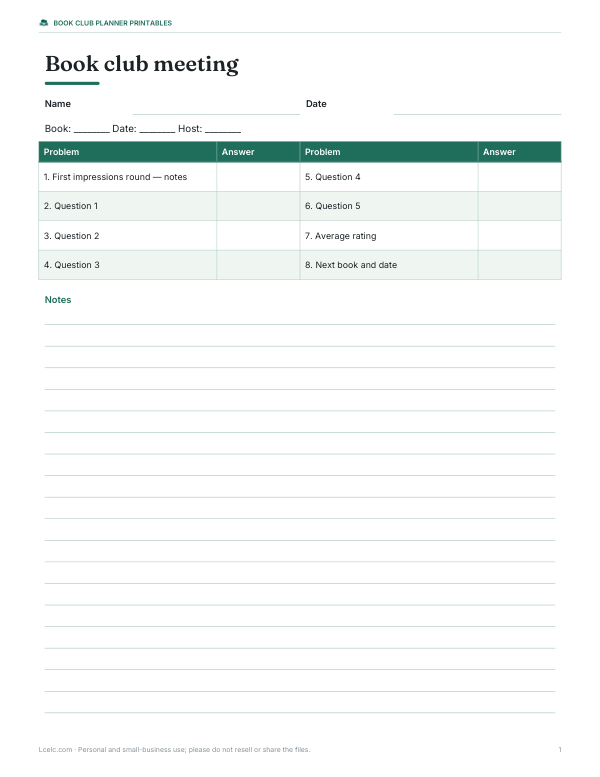
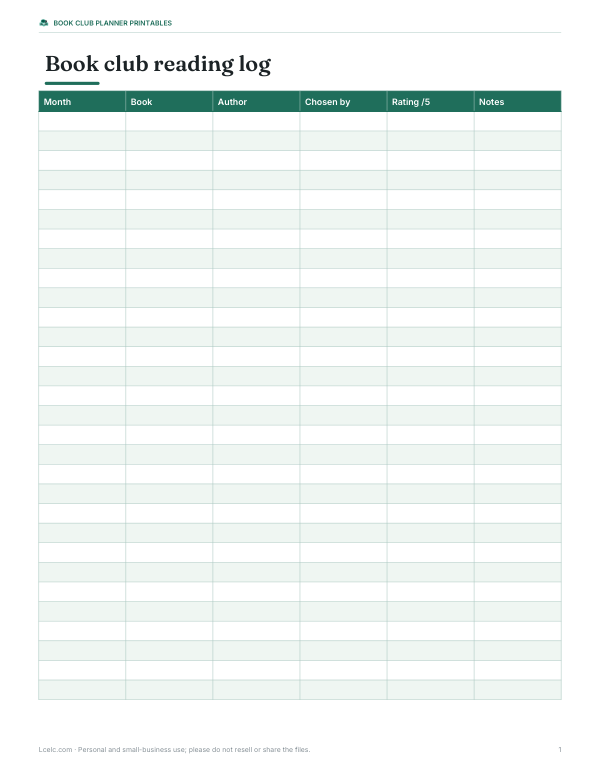
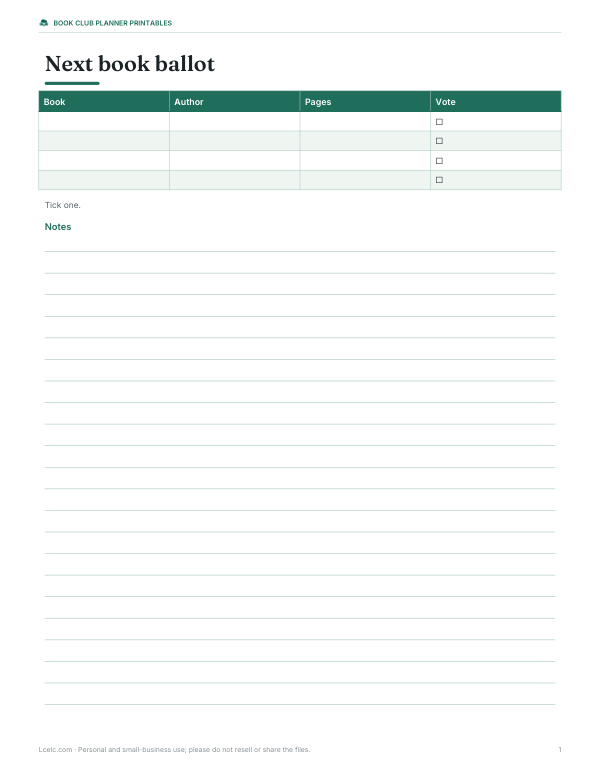
Editable host meeting sheet, reading log, next-book ballot and annual schedule. All four PDFs are free; the $3 pack adds three DOCX files and one XLSX file for reuse.
- Meeting sheet (DOCX/PDF)
- Reading log (PDF/XLSX)
- Voting ballot (PDF)
- Year schedule (PDF)
Formats: PDF, DOCX, XLSX. Instant download after payment (link valid 72 hours, up to 5 downloads). AI-assisted: AI tools were used to help draft these materials.
$3.00 USD, one-time
- Instant download
- 7-day refund
- Secure checkout by Stripe
7-day money-back guarantee. Full refund within 7 days of purchase, even after you download.
Full refund within 7 days — see the refund policy and license.
Free printables
Single sheets you can print right now, no sign-up. The full pack adds every sheet in one download plus the editable files.
 Book club annual schedule
What makes a good book club question
- Open-ended — it can’t be answered with yes or no.
- Personal — it invites members to connect the book with their own experience.
- Specific enough — it points to a character, scene or idea so people have something concrete to discuss.
- Room for disagreement — the best discussions happen when readers see things differently.
- Spoiler-aware — agree beforehand that everyone has finished, or save the ending for last.
How to use the generator
- Type the book title — it appears in the questions and on the printout.
- Choose the kind of book; mysteries, fantasy, memoirs and nonfiction get questions suited to them.
- Tick the topics your group enjoys most.
- Choose 4–20 questions. Custom questions count toward the total; duplicate prompts are removed.
- Add any questions of your own, such as ones from the author’s website or your notes.
- Shuffle until you like the mix, then print the sheet or copy the list.
These are general prompts, not a book-specific reading guide. Keep the ones that fit your reading and add page references or examples. If the selection has too few distinct prompts, the tool tells you instead of repeating questions.
Running a great meeting
| Time | Activity |
|---|---|
| 0–10 min | Arrivals, drinks and catching up |
| 10–20 min | Quick round: everyone gives a one-sentence first impression |
| 20–75 min | Discussion questions, moving from light to deeper |
| 75–80 min | Everyone rates the book out of 5 |
| 80–90 min | Choose the next book and date |
A host or rotating facilitator keeps time, draws in quieter members and moves on when a topic has run its course.
Worked example
For a ten-question discussion, select the topics your group wants to cover and add two questions of your own. The generator supplies up to eight other distinct prompts, for ten in total. Check that the wording fits the book, then copy or print the final list. The timing is a planning assumption; groups can discuss fewer questions in greater depth.
Questions by type of book
| Kind | Extra focus |
|---|---|
| Mystery / thriller | Clues, red herrings, suspense and the reveal |
| Fantasy / sci-fi | World-building, rules of magic or technology, real-world parallels |
| Memoir / biography | Honesty, memory and what the author chose to include |
| Nonfiction | Evidence, surprising ideas and what readers might do differently |
Keeping the conversation balanced
- Go round the circle for the first question so everyone speaks early.
- Ask “what makes you say that?” to deepen answers.
- If one person dominates, invite others by name: “What did you think, Sam?”
- It is fine to disagree — ask people to point to the page that shaped their view.
- Park off-topic tangents for after the discussion.
Icebreakers and activities
- One-word review: each member sums up the book in a single word before discussion starts.
- Casting call: who would play the main characters in a film?
- Quote swap: everyone brings a favourite line and explains why it stood out.
- Map it: for books with journeys, sketch the route on a big sheet of paper.
- Themed snacks: food or drink that appears in the book.
- Alternative ending: in pairs, pitch a different ending in two minutes.
Online and hybrid book clubs
Video meetings work well with a few adjustments: send the questions in advance, use a facilitator to call on people so they don’t talk over each other, and keep meetings to about an hour because screen fatigue sets in sooner. The chat box is useful for sharing favourite quotes while someone is speaking. For hybrid groups, place the laptop so remote members can see everyone in the room, and ask remote members first on each question.
Starting a new book club
Five to twelve members is a comfortable size: enough for different views, small enough that everyone speaks. Agree the basics at the first meeting — how often you meet, how books are chosen, whether you will read fiction, nonfiction or both, and whether members must finish the book. Monthly meetings with a four-week reading window suit most busy readers.
Discussing a book you disliked
Some of the liveliest meetings are about books half the group didn’t enjoy. Ask what the author was trying to do, whether it worked for anyone, and which parts made readers put the book down. Disagreement is welcome as long as it stays about the book, not the person who chose it.
Choosing the next book
Many clubs take turns choosing, or shortlist three books and vote. Consider length (some members have less time), availability in libraries, and variety across the year — mixing classics, new releases, nonfiction and books from different countries keeps discussions fresh. The printable pack includes a book voting sheet and a reading log for the year.
Privacy
The generator runs in your browser; your book titles and questions aren’t sent anywhere.
Frequently asked questions
What are good book club questions?
Open-ended questions about characters, plot, themes and your personal reactions.
How many questions should a book club discuss?
About 8–12 for a one-hour discussion.
Can I use the questions for any book?
The prompts are general and do not analyse the title. Select and adapt the ones that fit your book.
Can I add my own questions?
Yes. They count toward your chosen total. If there are too many, the tool asks you to adjust the count or remove some; it does not silently drop them.
Can I print the questions?
Yes, with a simple meeting agenda.
Is my book list saved?
No, nothing is stored or sent.
How long should a book club meeting last?
Usually 60–90 minutes including social time.